Cost control strategies for rapidly growing fleet companies are essential because expansion increases operational complexity faster than revenue. Without structured cost visibility, expenses scale unpredictably, and margins compress despite higher fleet size. For fleet owners, COOs, CFOs, and scaling rental operators, prioritizing financially strategic, operations-focused cost management is not just prudent—it’s the difference between sustainable growth and margin erosion.
Critically, cost control must be designed into the operational architecture—not enforced reactively. As fleets expand, traditional methods of cost tracking and control quickly become obsolete. Successful companies embed cost discipline into each operational phase: from intake, through traffic allocation, workshop lifecycle, replacement planning, financial logging, to unified dashboard control. This article details how to stabilize cost per vehicle, protect revenue per vehicle (RPV), contain overhead, and enable long-term scaling without margin compression using a structured, cause-and-effect approach.
Understanding Cost Density During Growth
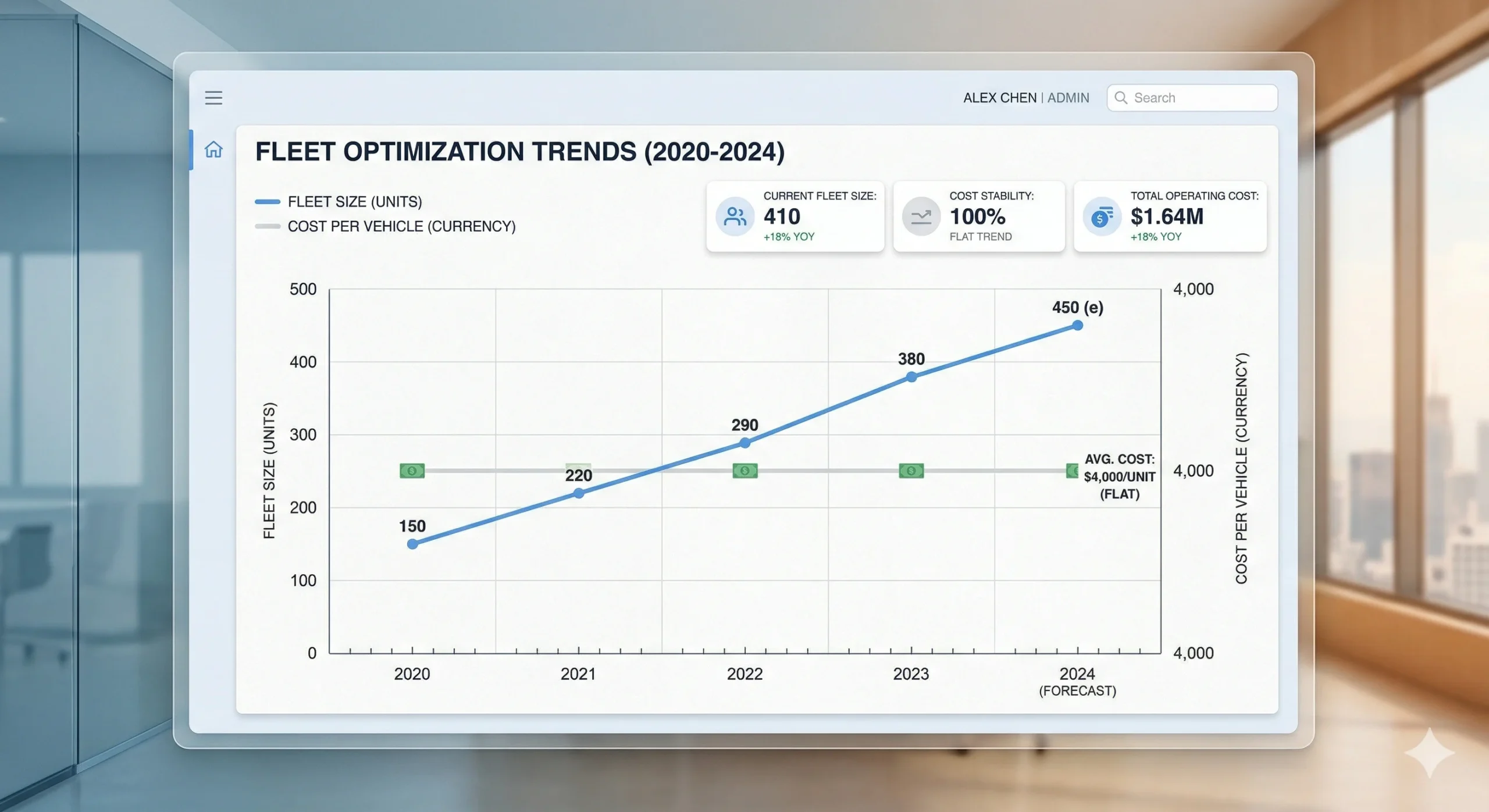
At the core of cost control strategies for rapidly growing fleet companies is the concept of cost density—how much operational expenditure is concentrated per vehicle as the fleet scales. Consider two crucial metrics: cost per vehicle and total cost. While total cost measures the aggregate spend, cost per vehicle reveals the efficiency (or inefficiency) of each asset’s contribution to profit.
During growth, variable costs (fuel, maintenance, repairs) and structural costs (depreciation, insurance, technology systems, overhead) expand. However, minor inefficiencies—such as slight over-ordering of parts, delayed approvals, or inconsistent vendor pricing—get multiplied across every additional vehicle. A 2% inefficiency in maintenance costs may seem trivial at 100 vehicles, but when scaled to 2,000, it becomes a significant expense that materially impacts margins.
Moreover, as new vehicles enter the intake phase, onboarding costs (registration, inspection, initial maintenance) spike, further distorting cost-per-vehicle stability. Without granular visibility and proactive controls, unchecked cost density can rapidly erode profitability.
Stabilizing Revenue Per Vehicle to Control Cost Ratio
Protecting the revenue per vehicle (RPV) is as critical as controlling costs. Stable RPV enables better absorption of fixed and variable expenses, resulting in healthier margins.
- Utilization Tracking: Implement dynamic utilization monitoring to maximize the number of revenue-generating days per asset. Advanced telematics and fleet management platforms provide real-time visibility into vehicle status, enabling proactive redeployment of underutilized assets.
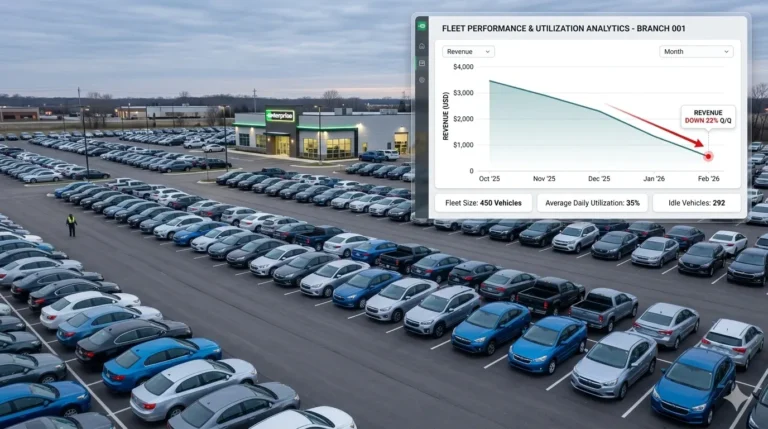
- Idle-Day Reduction: Even one or two idle days per vehicle per month can dilute revenue and skew the cost ratio. Automated traffic allocation ensures assets are consistently assigned, reducing non-billable periods.
- Downtime Compression: Every hour of downtime translates into lost revenue and higher per-unit costs. By integrating downtime tracking into the workshop lifecycle and traffic allocation phases, companies can minimize intervals between service completion and redeployment.
Cause-and-effect: When RPV is stabilized, each asset absorbs a greater share of overhead and variable costs. The result is a lower cost-per-revenue-dollar, allowing for more aggressive but sustainable fleet growth.
Controlling Repair & Downtime Cost
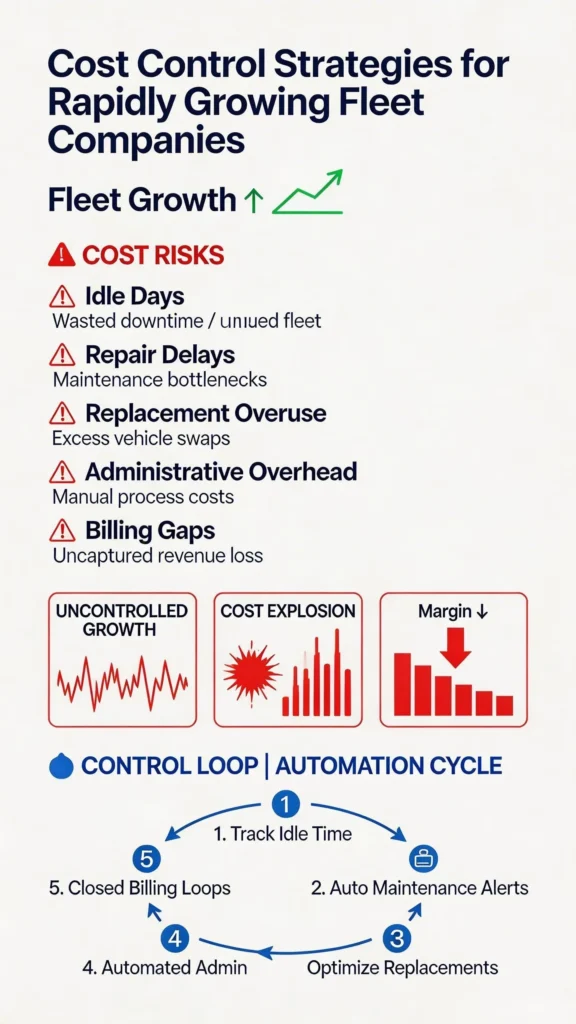
Repair and downtime costs are among the most significant—and often underestimated—drivers of fleet expense. Effective cost control strategies for rapidly growing fleet companies depend on minimizing both the direct and indirect costs associated with repairs.
- Repair Cycle Tracking: Implement end-to-end repair cycle monitoring, from intake through completion. This provides clarity on average repair duration, bottlenecks, and recurring pain points.
- Approval Automation: Delayed repair approvals increase vehicle inactivity. Automated workflows accelerate decision-making, ensuring prompt commencement of necessary repairs.
- Vendor Management: Maintain a vetted, performance-tracked vendor pool. Transparent vendor scorecards and rate benchmarking minimize cost variability and incentivize timely, quality service.
- Parts Procurement Visibility: Real-time parts inventory and procurement analytics reduce over-ordering and prevent costly last-minute sourcing.
Downtime acts as a cost multiplier—not only eliminating revenue from affected vehicles, but also increasing per-unit overhead as total available fleet utilization drops. The workshop lifecycle must be engineered for speed, transparency, and accountability to control these costs.
Replacement Cost Optimization
Replacement planning is a pivotal phase in fleet cost control. Poorly managed replacement processes lead to unnecessary capital expenditure, increased downtime, and misallocation of premium assets.
- Replacement Duration Control: Establish clear timelines for end-of-life asset replacement. Delays result in extended periods of non-revenue-generating vehicles, compounding total costs.
- Pool Optimization: Centralize and optimize the replacement pool. By tracking replacement needs and matching assets to demand, companies avoid premature purchases and maximize the lifespan of existing inventory.
- Forecasting Demand: Utilize predictive analytics to anticipate replacement spikes, thereby smoothing capital outlay and minimizing last-minute, high-cost acquisitions.
- Avoiding Premium Asset Misuse: Assign high-value vehicles only to revenue streams that justify their cost. Misusing premium assets for low-margin contracts artificially inflates cost-per-vehicle and erodes net profit.
Effect: Inefficient replacement planning increases cost density. Each day an asset sits idle awaiting replacement, or each instance a premium vehicle is allocated sub-optimally, the overall cost-per-vehicle climbs sharply.
Administrative Overhead Control
Administrative overhead expands rapidly during periods of growth, especially if unchecked by system design. The default solution—hiring more staff—rarely delivers sustainable efficiency.
- Automation vs. Hiring: Leverage workflow automation to handle routine administrative tasks, from contract processing to repair approvals. This reduces the need for incremental headcount with each fleet expansion.
- Workflow Standardization: Standardized operational processes minimize variance, reduce errors, and accelerate task completion. Clearly defined escalation paths and operating procedures prevent costly confusion.
- Escalation Reduction: Escalations consume valuable management bandwidth and introduce delays. Automated routing of exceptions based on predefined service-level agreements (SLAs) keeps operations flowing smoothly.
- SLA-Based Routing: Assign tasks based on SLA priorities, ensuring critical items receive immediate attention while routine matters are resolved efficiently in the background.
Cause-and-effect: A well-designed administrative architecture contains costs, eliminates redundancy, and enables the fleet to scale without proportional increases in overhead.
Financial Visibility & Real-Time Cost Control
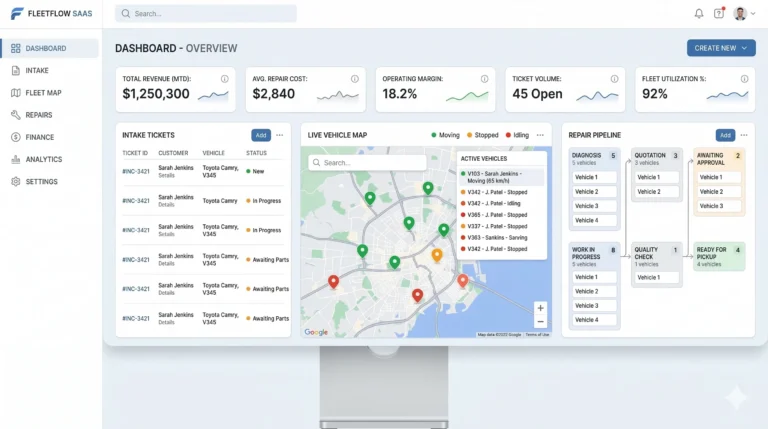
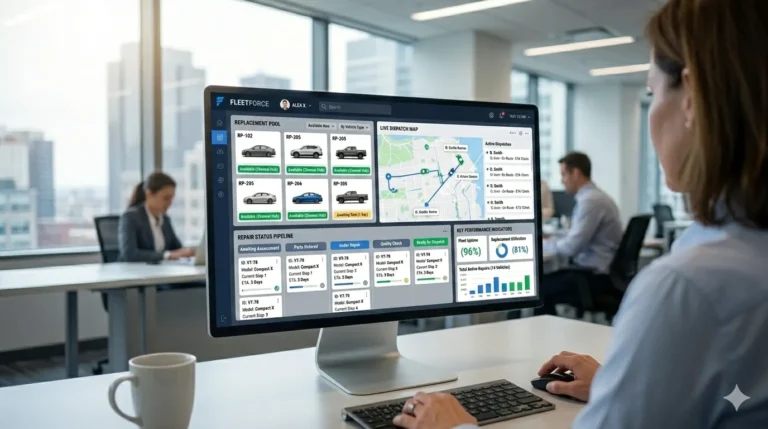
Financial logging and unified dashboard control are the cornerstones of modern cost control strategies for rapidly growing fleet companies. Real-time, actionable insights allow for proactive management and rapid course correction.
- Cost Per Repair Cycle: Track repair costs at the unit level to identify outliers and recurring inefficiencies.
- Revenue Per Vehicle: Monitor RPV in real time to spot underperforming assets and redeploy as necessary.
- Margin Per Asset: Calculate margins at the vehicle level, factoring in direct and indirect costs to prioritize profitable fleet segments.
- Replacement Ratio: Track the ratio of replaced to active units to optimize capital allocation and prevent over- or under-investment in new assets.
- Downtime Heatmap: Visualize downtime patterns by workshop, asset type, or operational segment to pinpoint systemic issues.
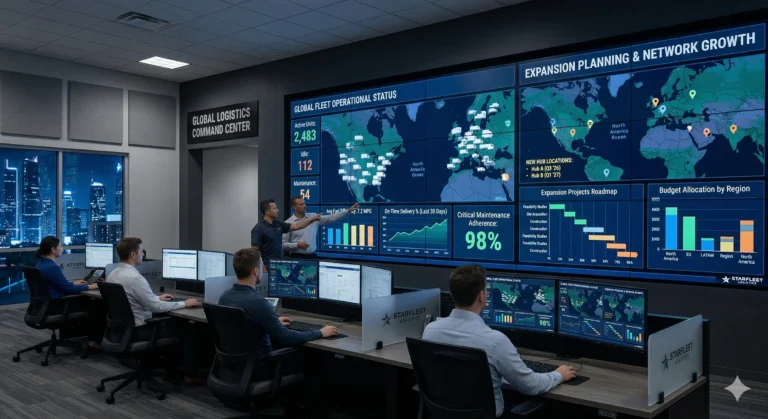
Unified dashboards provide a single source of truth, ensuring that all stakeholders—from finance to operations—have instant visibility into cost drivers and performance metrics. This continuous feedback loop empowers leadership to make informed, strategic decisions that protect margins and sustain growth.
FAQ: Cost Control for Rapidly Growing Fleet Companies
Why do costs increase rapidly during fleet expansion?
Because operational complexity rises exponentially with fleet size. Small inefficiencies multiply, fixed overhead grows, and managing more assets naturally introduces new cost centers unless proactively controlled.
How can fleets control cost per vehicle?
By tracking and optimizing variable and structural costs at the asset level, automating workflows, and using real-time dashboards for continuous monitoring and intervention.
What is the biggest hidden cost in fleet growth?
Downtime is often underestimated. Each inactive vehicle not only fails to generate revenue, but also absorbs overhead, driving up overall cost density.
How does downtime increase expenses?
It reduces utilization rates, forces unnecessary asset purchases, and extends the payback period for each vehicle, compressing margins.
What KPIs help control fleet costs?
Key KPIs include cost per vehicle, revenue per vehicle, repair cycle cost, margin per asset, downtime rate, and replacement ratio.
Conclusion
Cost control strategies for rapidly growing fleet companies determine whether expansion leads to profitability or margin erosion. Companies that stabilize cost per vehicle and protect revenue per asset scale sustainably.