
Hiring more CCE staff is the most common reaction when customer complaints increase in a rental company. However, hiring more CCE staff does not always solve operational problems. In fact, once fleet complexity increases, hiring more CCE staff can actually amplify coordination chaos instead of fixing it.
The Early Growth Fix — More Staff
In the early stages of fleet expansion, the operational landscape is relatively simple. As the number of vehicles grows, so does the volume of calls regarding breakdowns, booking queries, and customer complaints. The immediate, tactical fix is obvious: hire more agents to handle the increased volume. This additional manpower delivers prompt relief. Customers experience shorter wait times, and issues are logged faster. At this scale, the direct relationship between fleet growth and call volume makes expanding the CCE team an effective—albeit temporary—solution.
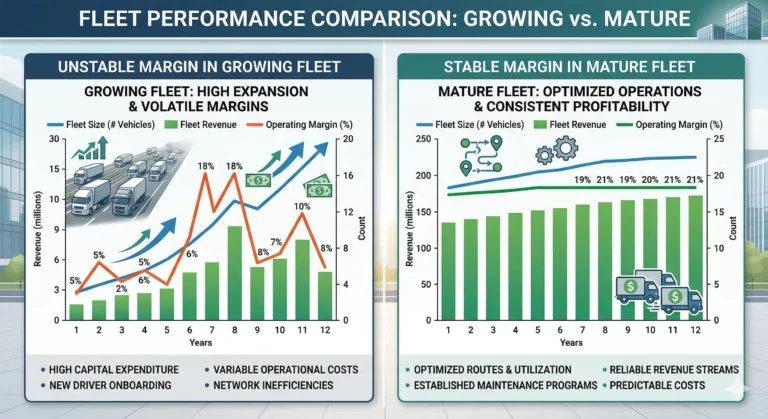
However, this strategy only works as long as the underlying tasks remain simple and the workflow is loosely coupled. Once a critical threshold is crossed, the complexity of coordination grows faster than the number of vehicles or CCEs, and the law of diminishing returns sets in.
The Bottleneck Shift
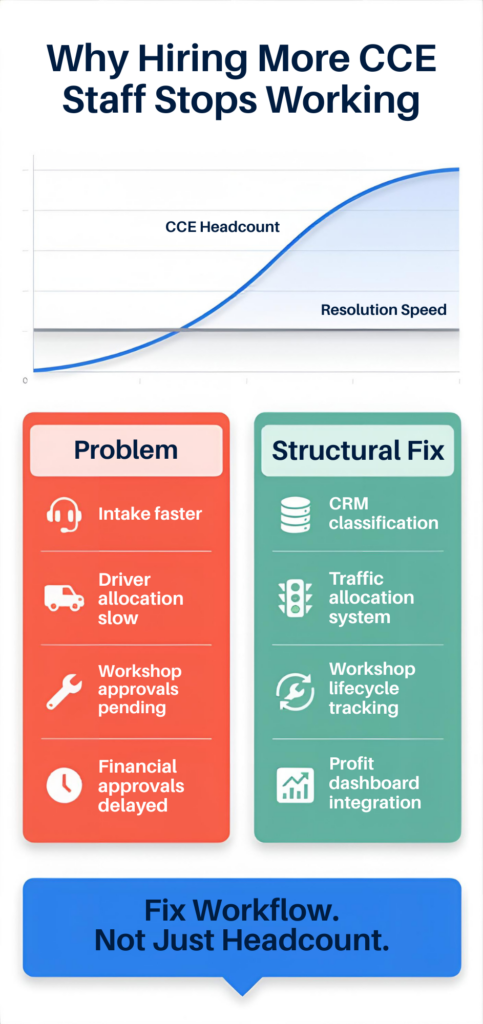
As operations mature, the real bottleneck shifts. Intake—the process of logging a customer complaint—becomes quicker with more CCEs. Yet, the actual resolution remains sluggish. Consider this sequence:
- A CCE logs a complaint about a breakdown.
- The traffic team cannot immediately assign a replacement driver.
- No available replacement vehicle exists in proximity.
- The workshop is waiting for approval to release a repaired vehicle.
In this scenario, hiring more CCEs accelerates the logging of complaints but does nothing to expedite the subsequent workflow stages. Intake speed improves, but resolution speed stagnates. Operationally, the process flows from intake to traffic allocation, then to workshop coordination, finance approval, and finally dashboard synchronization. If any stage lags, the entire chain slows, regardless of how quickly the initial complaint is registered.
Why Communication Volume Is Not the Root Cause
Many leaders assume that an increase in communication volume is the root cause of delayed resolutions. In reality, it is workflow fragmentation that hampers performance. Fragmented classification leads to tickets being misrouted or deprioritized. Manual follow-ups become necessary due to lack of system integration. When urgency is not algorithmically classified, critical issues languish in queues. Moreover, with no centralized visibility, team members lose context, making coordination cumbersome.
Hiring additional CCEs in this environment only amplifies operational noise. More agents mean more hands logging issues—but if workflows are not structured and information does not flow seamlessly, the result is confusion, duplication, and further delays.
Operational Density vs Staffing Density
The complexity of managing a fleet does not grow linearly with size. Instead, as the fleet expands, the number of task dependencies and coordination points increases exponentially. Each additional vehicle or team member adds new layers of communication and potential points of failure. More human nodes in the system mean more meetings, messages, and manual interventions.
Consequently, operational density quickly outpaces staffing density. Attempting to bridge this gap with headcount alone is a losing battle. What is required is not more staff, but infrastructure—automation, structured dashboards, and digital workflows—that reduces coordination overhead and enables rapid, data-driven decision-making.
The Real Solution
Ultimately, operational excellence is achieved not by expanding CCE headcount, but by engineering a closed-loop system that unifies workflows. The following strategies are essential:
- Centralize Customer Intake: Route all complaints and queries through a unified platform to ensure no issue is lost or duplicated.
- Automate Urgency Classification: Use algorithms to flag high-priority cases, ensuring the right issues are escalated instantly.
- Connect CCE Tickets to Traffic Allocation: Integrate CCE systems with traffic management so that vehicle and driver assignments occur seamlessly.
- Integrate Workshop Tracking: Connect workshop approval and repair status directly to support tickets, reducing manual follow-ups.
- Sync Financial Impact to Dashboard: Link every case to its financial impact, allowing management to see real-time cost implications and prioritize accordingly.
This closed-loop operational system minimizes human handoffs, accelerates resolution times, and provides management with the visibility required to address systemic issues—not just symptoms.
FAQ: Addressing Common Operational Challenges
Because the root cause is workflow fragmentation, not lack of intake capacity. Without systemic changes, complaints only move through the system faster—not to resolution.
When call intake speed is no longer the limiting factor, and bottlenecks appear in traffic, workshop, or finance workflows. This is often indicated by rising ticket backlog despite a larger CCE team.
Dependency on manual processes, fragmented communication, and lack of integrated systems are the primary culprits.
Slow or inefficient traffic allocation causes delays in vehicle replacement and recovery, directly affecting customer satisfaction.
Automation can streamline and enhance CCE roles, especially for routine tasks like ticket classification, routing, and status updates—but human oversight remains essential for complex or sensitive cases.
Conclusion
If your solution to rising complaints is hiring more CCE staff, you are treating the symptom—not the system. True operational stability comes from structured workflow, not staffing expansion. The most successful rental companies scale their systems first, and their staff second. This strategic focus enables sustainable growth, higher customer satisfaction, and a resilient business operation.