
Accident management is one of the most critical and complex challenges facing large rental fleet operators today. As your fleet grows, the operational complexity of managing incidents increases at a pace that quickly outstrips traditional reporting structures. This isn’t just a matter of handling more paperwork. The stakes are higher: accident frequency rises, multi-party coordination becomes harder, cost exposure expands, and documentation gaps multiply. Consequently, what once felt manageable in a smaller operation can spiral into disarray — unless robust systems are established early.
Why Accident Volume Scales Nonlinearly
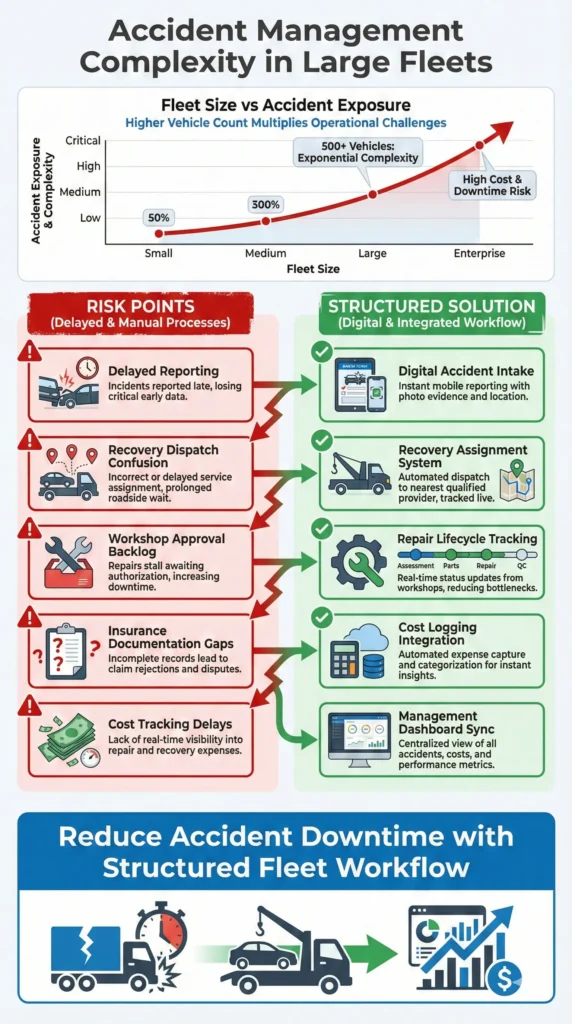
It’s a common misconception that doubling your fleet simply doubles your accident risks. In reality, the relationship is nonlinear. More vehicles mean more road exposure hours, dramatically increasing the probability of incidents. Moreover, with more drivers, behavioral variance rises; not all drivers adhere to the same safety standards or reporting protocols. Higher utilization — that is, more vehicles being used more often — also concentrates risk. Therefore, accident handling complexity doesn’t just grow with fleet size, it accelerates faster. Without the right processes, every new vehicle adds disproportionately to your operational risk.
The First Breakdown: Accident Reporting Chaos
The initial point of failure in large fleets is often accident reporting. Delays in driver reporting are common, especially when operators lack seamless communication channels. Incomplete documentation further hinders effective claims processing. Notably, many incidents are reported without photo evidence, making it difficult to verify claims or defend against disputes. Manual claim logging is still prevalent in many organizations, leading to errors, omissions, and lost data. Customers, especially in rental scenarios, can be confused or uncooperative during exchanges, exacerbating the chaos. Ultimately, the absence of a centralized, standardized intake system leads to a breakdown in classifying accidents as urgent versus non-urgent — a distinction that is critical for appropriate resource allocation and response prioritization.
Traffic & Recovery Coordination Failure
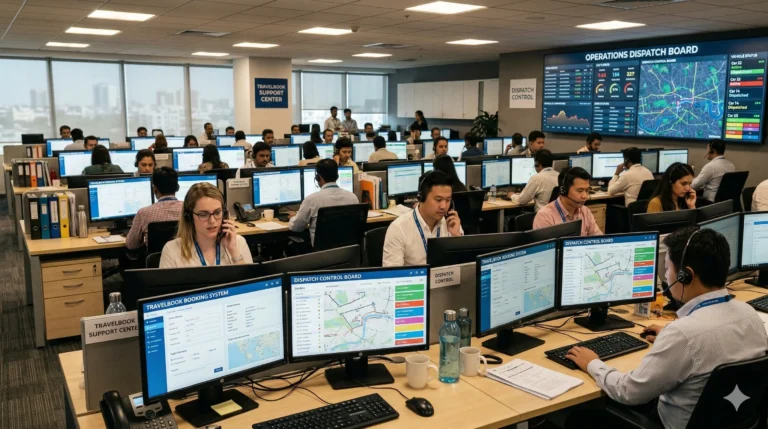
Once an accident is reported, the next challenge is coordinating traffic and recovery operations. Dispatch confusion is a frequent issue, as unclear communication between dispatchers and field teams leads to delayed or duplicated recovery efforts. Tow vehicle delays are a significant pain point, especially when fleet managers rely on third-party providers without robust service-level agreements. Moreover, replacement vehicle unavailability can frustrate customers and disrupt business continuity. Poor real-time vehicle tracking compounds these challenges, as operators struggle to locate vehicles quickly or assign the nearest recovery unit. Therefore, structured traffic dashboards and automated recovery assignment workflows are essential. These tools provide real-time visibility and coordination, reducing delays and enhancing operational efficiency.
Workshop & Insurance Bottlenecks
Even after a vehicle is recovered, new bottlenecks emerge at the workshop and in insurance coordination. Quotation delays are common, particularly when workshops are overloaded or lack digital work order management. Approval waiting periods further extend vehicle downtime, as internal or insurer approvals are often siloed and slow. Insurance coordination gaps can cause claims to stall or fall through the cracks entirely. Most critically, the repair lifecycle is rarely tracked end-to-end, resulting in uncertainty about vehicle status. As a result, lack of repair status visibility directly increases idle time, further eroding profitability and customer satisfaction.
Financial & Liability Exposure
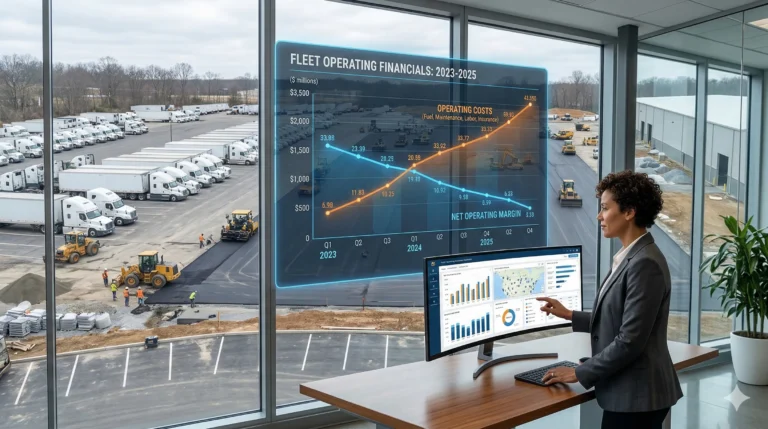
Operational inefficiencies in accident management have direct financial consequences. Hidden repair cost escalation is a real threat when costs are not logged in real-time or benchmarked against historical data. Delayed cost logging leads to inaccurate financial reporting and unanticipated budget overruns. Claim disputes frequently arise when documentation is incomplete or ambiguous. Incentive misalignment — such as drivers, workshops, or agents prioritizing speed over accuracy — further undermines process integrity. Consequently, per-vehicle profitability tracking and robust accident cost reporting are vital. These tools help operators identify loss-making vehicles and adjust risk management strategies proactively.
The Structural Fix: Closed-Loop Accident Management
So, how can large fleet operators regain control? The answer lies in adopting a closed-loop accident management model. This approach ensures that every incident follows a structured, documented path:
- Accident Reported: Incidents are reported via digital channels, ensuring time-stamped, geo-tagged, and photo-documented submissions.
- Classified and Documented: Accidents are immediately classified as urgent or non-urgent, with standardized checklists for documentation.
- Recovery Dispatched: Automated workflows trigger rapid recovery assignments, leveraging real-time vehicle tracking and dispatch dashboards.
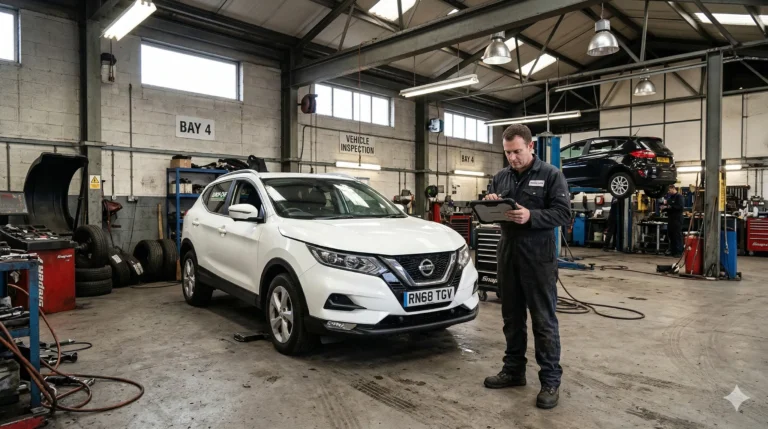
- Workshop Inspection Initiated: Vehicles are routed to pre-approved workshops, with digital inspection and repair requests logged instantly.
- Cost and Claim Recorded: Repair costs, insurance claims, and customer charges are captured in a unified ledger, updated in real-time.
- Dashboard Updated: Management dashboards reflect the latest status, enabling operational leaders to monitor progress and intervene proactively.
This closed-loop structure reduces downtime, minimizes cost leakage, and ensures that every stakeholder — from drivers to risk managers to finance teams — operates from a single source of truth.
FAQ: Accident Management in Large Fleets
As fleet size grows, the number of accidents rises disproportionately due to more vehicles, drivers, and usage hours. Coordination, documentation, and cost tracking all become exponentially more complex
Fleet management software streamlines accident reporting by enabling real-time, digital submissions with mandatory fields for details and photos, reducing delays and incomplete documentation.
Delays stem from unclear dispatch protocols, lack of real-time vehicle tracking, and limited availability of tow or replacement vehicles. Automated workflows and dashboards mitigate these issues.
Slow or siloed approval processes at workshops — and between workshops and insurers — significantly extend vehicle idle time. Digital approval workflows and transparent status tracking accelerate turnaround.
Incomplete or inconsistent documentation weakens the company’s position in claims, leading to disputes, denied claims, or suboptimal settlements from insurers
Conclusion
Accidents are inevitable in large fleets. Chaos is not. Companies that integrate accident reporting into a structured workflow prevent revenue leakage, reduce idle days, and protect customer satisfaction. Ultimately, the key is to scale your accident management systems before accident volume scales your losses.