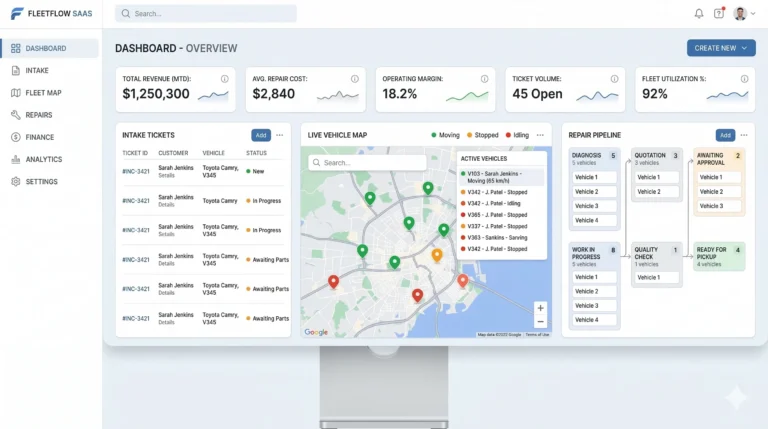

Service delays silently reduce revenue per vehicle because downtime expands beyond the visible repair window. While fleet operators focus on repair completion dates, the real revenue loss occurs due to scheduling gaps, approval delays, and redeployment lags. For rental fleet owners, operations heads, and finance managers, service delays are not just a logistical inconvenience—they’re a direct threat to per-vehicle profitability.
The Hidden Downtime Window
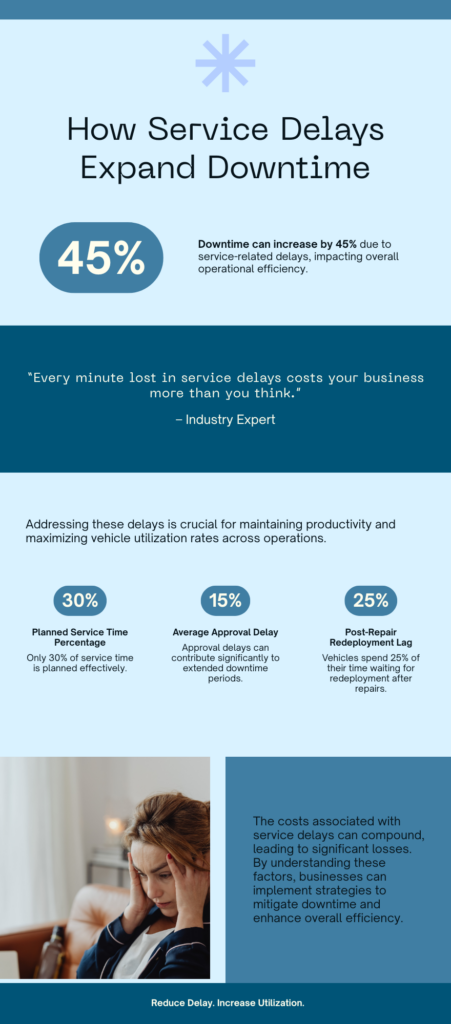
When a vehicle is flagged for service, the clock starts ticking long before it enters the workshop. First, there’s the gap between the service trigger—whether a dashboard warning, mileage threshold, or customer report—and actual workshop intake. Vehicles often sit idle awaiting internal approvals, parts procurement, or available workshop slots. Each step adds invisible days to the service cycle.
Moreover, once a vehicle enters the repair queue, it may wait further due to technician backlogs or parts shortages. Even after repairs are completed, post-repair redeployment lag can quietly extend downtime. Vehicles await final inspections, cleaning, or administrative clearance before they re-enter the rental pool. Therefore, total downtime encompasses pre-service waiting, in-workshop delays, and the lag before redeployment. The cumulative impact is a hidden drain on fleet productivity and revenue.
Overlapping Maintenance Cycles
Poorly managed maintenance cycles often cause multiple vehicles to require service simultaneously. Preventive maintenance clustering—where batches of vehicles reach service thresholds together—can overload workshops. Without mileage-based automation to stagger appointments, vehicles pile up, prolonging idle periods.
Furthermore, lack of workshop slot forecasting compounds the problem. When upcoming service needs aren’t anticipated, workshops are either overwhelmed or underutilized. Consequently, vehicles queue unnecessarily, and replacement strain increases as the available rental pool shrinks. Overlapping maintenance cycles multiply idle days and reduce overall fleet availability—directly undermining revenue per vehicle.
Allocation & Booking Disruption
Service delays have operational ripple effects that extend well beyond the workshop. Bookings may need to be rescheduled, leading to dissatisfied customers and lost repeat business. Replacement vehicles, intended for emergencies, are reassigned to cover extended service delays, disrupting planned allocations and dispatch schedules.
Notably, such instability creates a cascade of inefficiencies: scheduled rentals are canceled or modified, dispatch teams scramble to rebalance the fleet, and customer confidence erodes. Over time, the reputational cost can be as damaging as the financial impact. Ultimately, service delays not only reduce revenue per vehicle but also destabilize customer relationships and operational reliability.
Financial Erosion
The most immediate and measurable consequence of service delays is financial erosion. Every additional day a vehicle spends off the road translates into lost rental days and a reduced utilization rate. Moreover, delays often escalate minor issues into costly emergency repairs, further eroding margins.
Delayed service completion pushes back revenue recognition—especially in corporate rentals or long-term contracts—impacting cash flow and financial reporting. Lower average revenue per vehicle becomes inevitable as lost days accumulate. Consequently, without real-time, dashboard-level monitoring of service cycles, these losses can remain obscured until they aggregate into significant margin leakage.
Structured Service Control Model
To combat these issues, a structured service control model is essential. The workflow should begin with a clear service trigger—whether automated or manual—which is immediately matched to an available workshop slot. Throughout the repair stage, progress should be tracked in real-time, with replacement vehicles synchronized to minimize allocation strain.
Cost logging at every phase provides transparency and supports financial analysis. Critically, redeployment visibility ensures that vehicles return to service as soon as possible, closing the loop on downtime. When each stage is synchronized, fleet operators can protect revenue by minimizing idle time and maximizing per-vehicle productivity.
FAQ: Service Delays and Revenue Impact
Service delays extend vehicle downtime, reducing the number of days a vehicle is available for rental. Fewer rental days directly lower revenue per vehicle and can also increase indirect costs
Downtime includes the entire period from when a vehicle is flagged for service to when it is redeployed—encompassing pre-service lag, workshop repair time, and post-repair administrative delays.
If preventive maintenance is scheduled without considering mileage, usage patterns, or staggered intervals, multiple vehicles may require service simultaneously, overwhelming workshops and increasing idle days.
Service scheduling can be optimized by using mileage-based triggers, automated scheduling tools, and workshop slot forecasting. This approach staggers appointments and reduces overlap.
Key KPIs include average downtime per vehicle, service completion rate, on-time redeployment, utilization rate, and average revenue per vehicle.

Conclusion
Service delays do not appear dramatic. They appear incremental. However, incremental idle days across hundreds of vehicles create measurable margin erosion. Shorten service cycles. Protect revenue per vehicle.
Moreover, continuous monitoring and rapid response to bottlenecks are crucial to sustaining operational efficiency. Every hour saved in the service cycle is an hour returned to revenue generation.
Ultimately, disciplined service management is a competitive advantage—transforming service from a cost center into a strategic lever for maximizing fleet returns.