
Managing a car rental fleet is a complex challenge. As a fleet grows beyond 200 vehicles, the cracks in legacy tools like Excel and WhatsApp become operational chasms. Car rental owners, transport managers, and decision-makers must confront a hard truth: what once worked for a dozen vehicles will ultimately fail at scale, not because staff are less capable, but because the systems themselves are fundamentally limited. This article explores why Excel and WhatsApp fail in high-volume fleet operations, how inefficiencies multiply, and why modern fleet management software is now essential.
The Scalability Problem: From Manual to Mission-Critical
The Hidden Costs of Scale
At 50 vehicles, juggling spreadsheets and chat groups may seem manageable. However, as the fleet expands to 200 or 300 vehicles, every manual process is amplified. Delays, errors, and missed tasks—minor at a small scale—become major operational risks. Each additional vehicle introduces more data, more drivers, and more customer interactions, exponentially increasing complexity.
Why Excel Fails in Real-Time Fleet Environments
No Workflow Automation
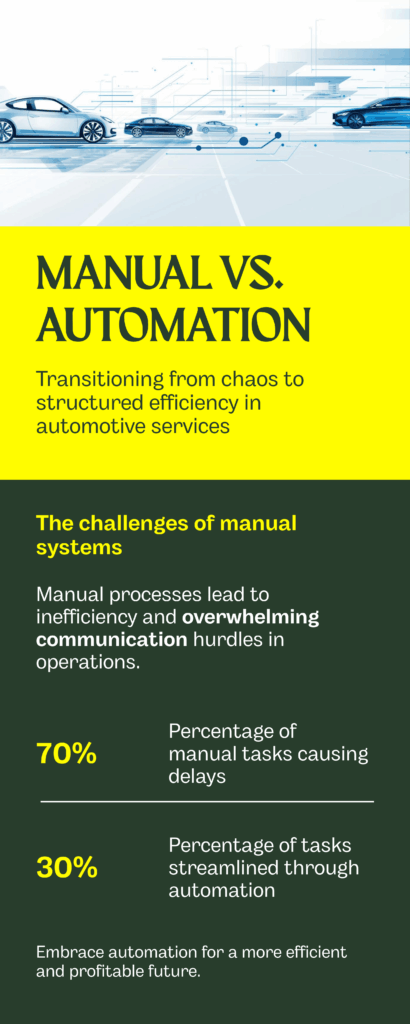
Excel is designed for static data, not for live, operational workflows. Fleet operations require real-time coordination: vehicles must be assigned, inspections tracked, maintenance scheduled, and issues escalated. Excel offers none of these automated triggers. Consequently, staff must manually update sheets, leading to bottlenecks and missed deadlines.
Absence of Role-Based Dashboards
Operational efficiency demands that each stakeholder—dispatchers, workshop managers, executives—see relevant data and actions. Excel cannot create dynamic dashboards that restrict or prioritize information by role. As a result, everyone sifts through the same cluttered files, increasing cognitive load and the likelihood of oversight.
No Live Asset Synchronization
A fleet of 300 vehicles is inherently dynamic. Vehicles move, statuses change, breakdowns occur. Excel does not support live asset sync, so there’s no single source of truth. Operators may be working from outdated sheets. In contrast, a vehicle tracking system integrated with fleet management software can update vehicle status in real time, reducing miscommunication and idle time.
Version Control and Data Integrity Issues
With multiple users editing the same spreadsheet, version conflicts are inevitable. Files become duplicated, overwritten, or corrupted. In an environment where every minute counts—such as assigning a recovery vehicle to a breakdown—these issues can result in costly delays or even lost revenue.
Why WhatsApp Fails as an Operational System
Lack of Structured Classification
WhatsApp is built for conversation, not operational rigor. Messages fly back and forth, but there’s no way to systematically classify tasks. For example, recovery and non-recovery incidents blur together, making it impossible to prioritize or audit later.
No Audit Trail
Fleet management demands accountability. WhatsApp offers no structured record of who did what, when, or why. If a vehicle’s maintenance was missed because a message was overlooked, it’s nearly impossible to determine where the failure occurred. This lack of audit trail exposes the business to compliance and safety risks.
No Urgency Routing
Operational workflows often hinge on urgency. A breakdown needs instant escalation, while routine service can wait. WhatsApp does not route messages based on urgency or asset criticality. Consequently, high-priority incidents can be buried under routine chatter, delaying response and increasing downtime.
No Dashboard Integration
WhatsApp is isolated from core business systems. There is no way to integrate WhatsApp conversations with a workshop management system, car rental CRM, or a fleet profitability tracking tool. This fragmentation forces staff to re-enter information across multiple platforms, multiplying the risk of error.
The Exponential Growth of Inefficiency
Operational Chaos at Scale
When a fleet is small, staff can compensate for system shortcomings with extra effort. At scale, manual workarounds become unsustainable. For every additional 100 vehicles, the number of daily interactions—bookings, maintenance, incidents—multiplies. The result is operational chaos: competing priorities, missed assignments, and mounting customer complaints.
Real-World Example: Breakdown Recovery
Imagine a 250-vehicle fleet with a 2% daily incident rate. That’s five vehicles per day requiring recovery or urgent intervention. Coordinating these incidents through Excel and WhatsApp means information is delayed, duplicated, or lost. The impact is not just operational—downtime grows, costs rise, and customer satisfaction drops.
Structured Workflow Architecture: The Modern Approach
To break this cycle, leading operators are adopting structured workflow architectures within centralized fleet management software. Here’s how these systems transform operations:
Customer Intake Classification (Recovery vs Non-Recovery)
Every customer request is automatically categorized. Recovery cases (e.g., breakdowns) are routed for urgent handling, while non-recovery tasks (routine service, document updates) follow a standard flow. This ensures that the most critical issues are surfaced immediately, not lost in a chat thread.
Traffic Dashboard and Driver Allocation
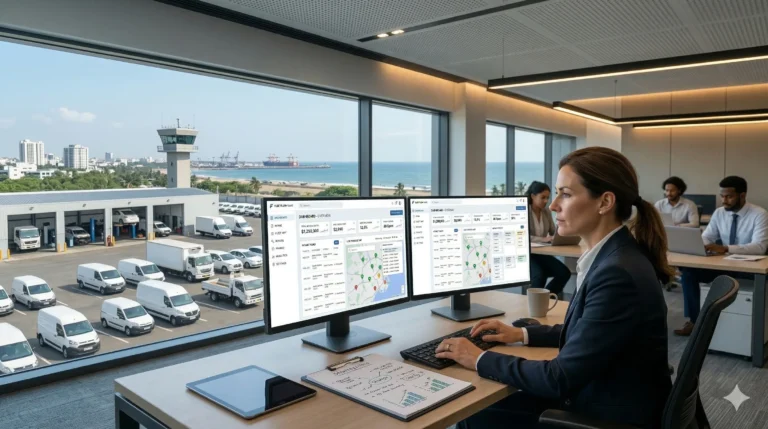
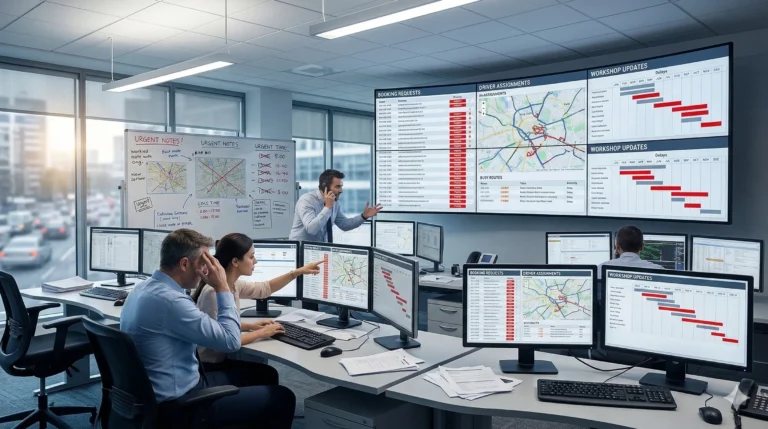
A live traffic dashboard displays all vehicles and their current status. Dispatchers can allocate drivers based on location, availability, and urgency, using real-time data from the vehicle tracking system. This replaces the guesswork and delays inherent to spreadsheets and chat groups.
Workshop Quotation Approval Flow
When a vehicle needs repairs, the workshop submits a digital quotation through the workshop management system. Approvals are tracked, and the system notifies relevant stakeholders automatically. This eliminates back-and-forth messaging and ensures timely, auditable decisions.
Driver Reporting with Photo Evidence
Drivers can report issues directly from their mobile devices, attaching photos as evidence. The data is immediately linked to the relevant vehicle record in the car rental CRM and fleet management software. This process ensures transparency, accountability, and faster problem resolution.
Profit Tracking Per Vehicle
Modern systems automate the tracking of expenses and revenue per vehicle. Fleet profitability tracking becomes continuous and granular, informing both operational and strategic decisions. Excel’s static nature makes this level of insight impossible at scale.
Management Dashboard Sync
Executives and managers access a synchronized dashboard that aggregates all critical metrics—utilization, downtime, profitability, compliance—from across the operation. This centralized view empowers data-driven decision-making and rapid response to emerging issues.
Centralized Fleet Management Software: A Structural Solution
The growing complexity of large fleets demands more than incremental process improvements. Centralized fleet management software offers an integrated, automated, and auditable environment tailored for operational scale. By unifying rental fleet automation, vehicle tracking, workshop management, and profitability analysis, these platforms resolve the structural limitations of Excel and WhatsApp.
Moreover, adopting a modern system is not about replacing staff—it’s about empowering them. When workflows are automated and information is centralized, staff can focus on high-value tasks: customer service, strategic growth, and continuous improvement.
The Bottom Line: Scale is a Systems Problem
Ultimately, the transition from manual tools to structured systems is not a question of staff performance. It is a recognition that scaling up is a systems problem. Tools like Excel and WhatsApp, while familiar, cannot deliver the reliability, speed, and accountability required by large fleet operations. Forward-thinking car rental businesses increasingly view investment in dedicated fleet management software not as a luxury, but as a necessity for sustainable growth.

FAQ: Fleet Operations and System Challenges
Excel cannot automate workflows, synchronize real-time asset data, or support role-based dashboards. As user numbers grow, version control issues and manual updates lead to errors and delays, making it unsuitable for large-scale fleet operations.
WhatsApp lacks structured task classification, urgency routing, and audit trails. While it can facilitate quick communication, it fails to provide the operational rigor needed for managing breakdowns and recoveries at scale.
As fleet size approaches 200 vehicles, manual spreadsheet management becomes unsustainable. Automation is strongly recommended when daily operational volume exceeds what can be reliably tracked and updated by hand—typically at 100–150 vehicles, and essential beyond 200.
Workflow classification ensures that urgent and routine tasks are identified and routed appropriately. This enables prioritization, faster resolution of critical issues, and a clear audit trail for compliance and accountability.