Managing 50 vehicles is coordination. Managing 500 vehicles is systems engineering.
For fleet owners, rental company directors, and automotive investors, scaling beyond 300–500 vehicles introduces a level of operational complexity that is both non-linear and, often, invisible—until a breakdown occurs. At this scale, challenges compound across every node of the operation. What once felt like process management now becomes a question of systems architecture. Understanding this transformation is essential for anyone preparing to scale, or already managing, a large fleet.
Why Complexity Multiplies at 500+ Vehicles
Growth in fleet size is not a simple matter of multiplying resources. Complexity expands exponentially due to the density and interdependence of workflows. Consider these factors:
- Vehicle Movement Density: As the number of vehicles rises, so do the routes, touchpoints, and interactions per vehicle. Routing and scheduling become a dynamic web rather than a linear path.
- Customer Communication Volume: Requests, complaints, and status updates multiply, straining communication channels and leading to information loss.
- Workshop Dependencies: Maintenance scheduling, repair approvals, and parts logistics compound, creating bottlenecks that ripple through the fleet.
- Driver Coordination: With more drivers, assignments overlap, last-minute changes surge, and coverage gaps emerge unpredictably.
- Cost Tracking Fragmentation: Expenses—fuel, tolls, claims—proliferate, making granular tracking and reconciliation a logistical challenge.
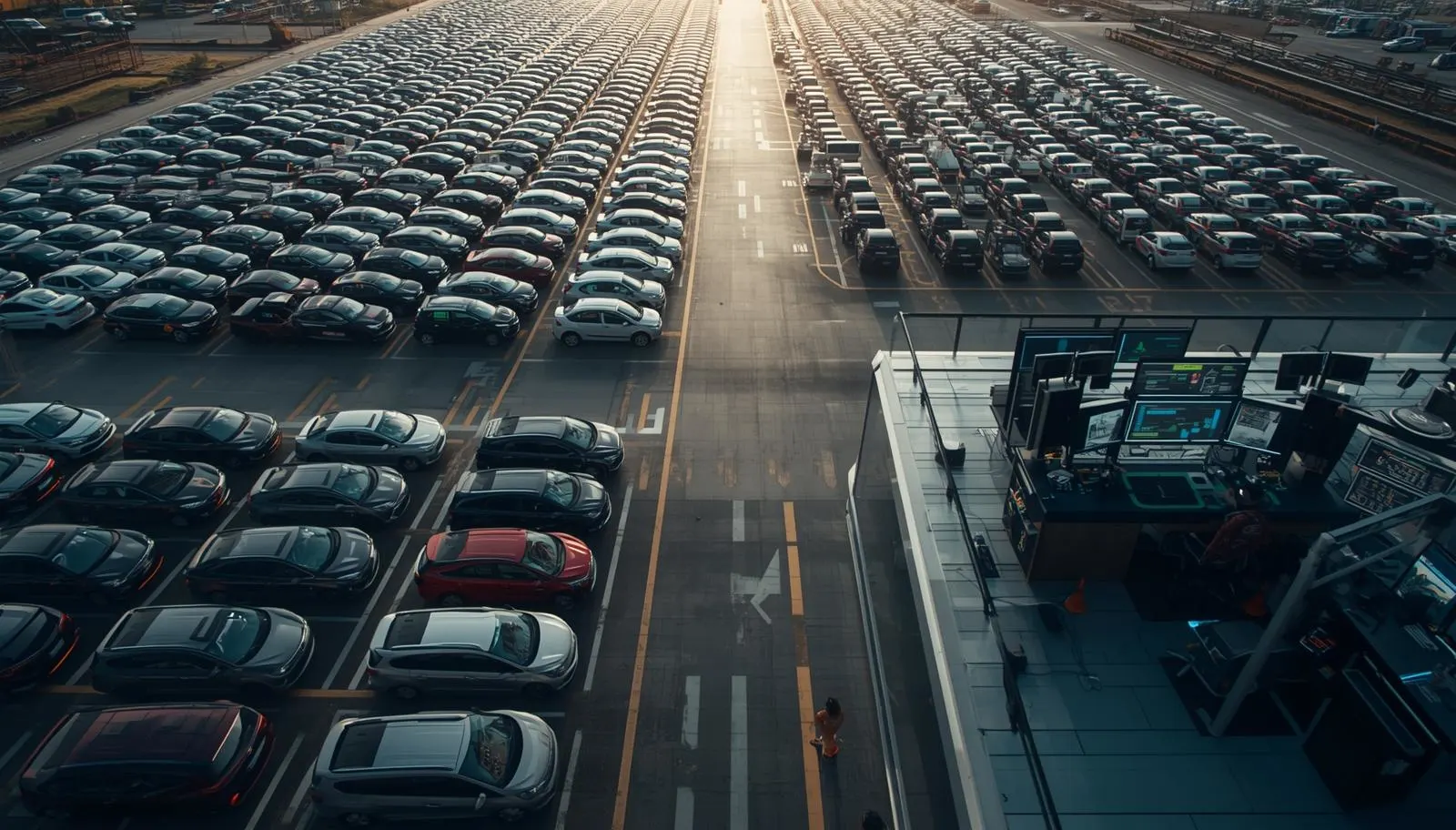
This is more than just growth. It’s workflow density: the frequency and complexity of interactions per asset, per day. At 500+ vehicles, the operation transforms from a set of tasks to an interlocking system where every delay or misstep can cascade.
The Operational Pressure Points
A. Customer Intake Overload
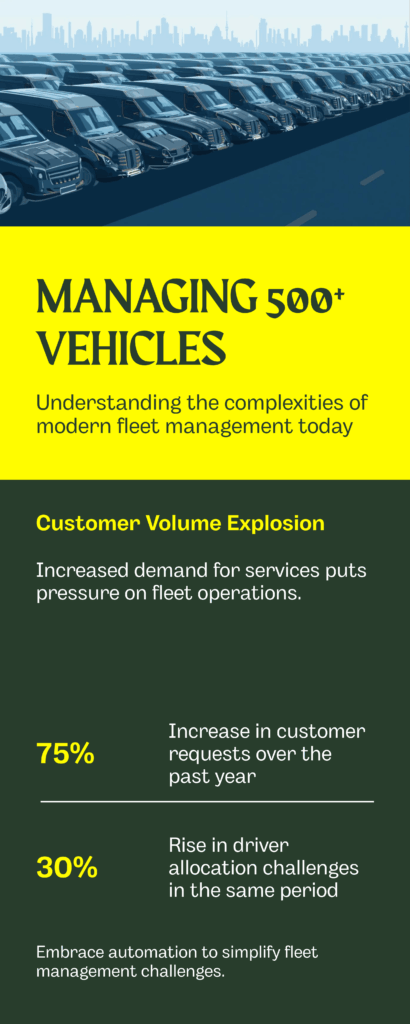
Without structured classification, the intake of customer requests turns chaotic. Urgent breakdowns and routine inquiries land in the same queue, leading to recovery mismanagement.
- Automated Routing: Only automated intake and routing can ensure urgent breakdowns bypass standard queues and reach the right team instantly.
B. Traffic & Driver Allocation Instability
Assigning drivers and vehicles at this scale is no longer a manual task. The risks multiply:
- Replacement Mismatches: Substituting a vehicle or driver without full visibility often leads to mismatches and lost billing days.
- Double Assignments: Assigning the same driver or vehicle to multiple jobs due to lack of real-time updates.
- Productivity Blind Spots: Without dashboards, underutilized vehicles and idle drivers go unnoticed.
C. Workshop Lifecycle Delays
Maintenance workflows are particularly vulnerable:
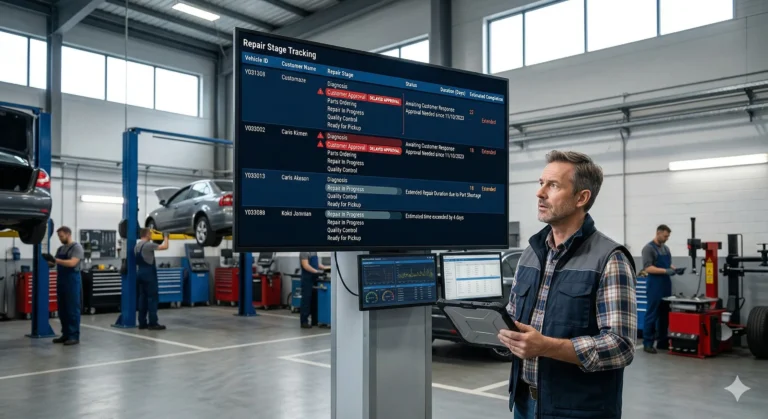
- Inspection Bottlenecks: Vehicles wait for inspection due to backlogs, stalling the entire repair chain.
- Approval Stalls: Manual quote approvals turn into multi-day delays with dozens of vehicles in the queue.
- Rising Idle Asset Days: Each stalled vehicle is a revenue drain, multiplying as the fleet grows.
D. Financial Opacity
At 500+ vehicles, cost management becomes a maze:
- Driver Claims: Manual review of claims leads to mistakes and delayed reimbursements.
- Toll/Fuel Reimbursements: Tracking expenses across hundreds of vehicles without automation results in leakage.
- Incentive Miscalculations: Bonus and incentive schemes become error-prone without integration.
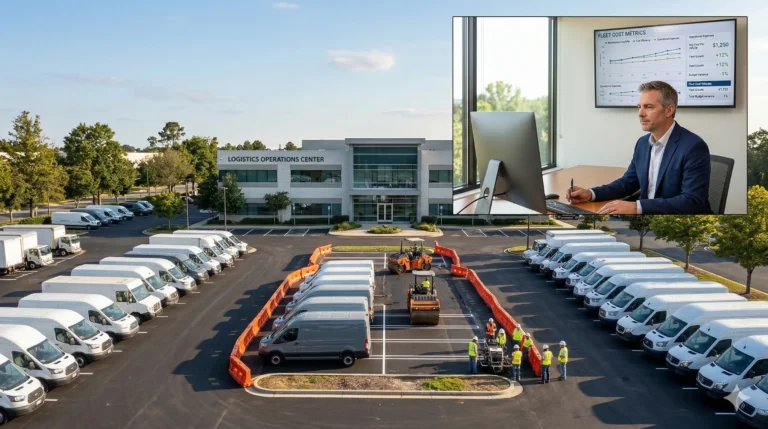
- No Per-Vehicle Profitability: Without a dashboard, it’s impossible to know which vehicles drive margin and which erode it.
Structured Workflow Dashboards: The Antidote
Every pressure point shares a solution: robust, structured workflow dashboards.
- Intake Forms: Standardized digital forms ensure every customer request is classified and routed efficiently.
- Resource Allocation Modules: Real-time visibility of vehicle and driver status eliminates double bookings and mismatches.
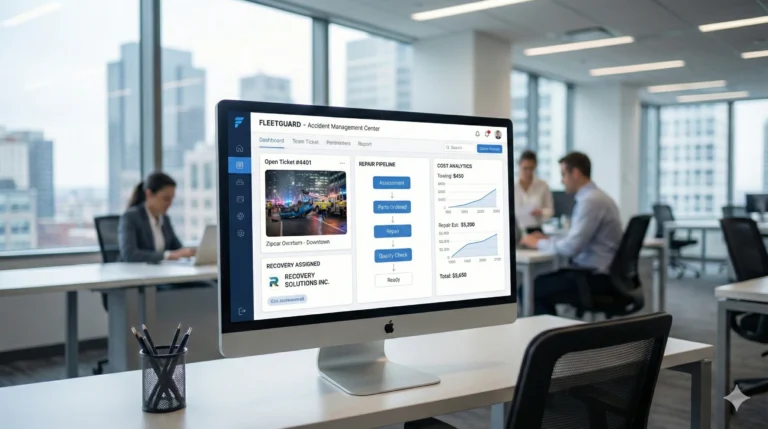
- Workshop Approval Pipelines: Automated approval flows accelerate repair cycles and reduce idle days.
- Mobile Reporting: Drivers and field staff upload documentation live, streamlining claims and compliance.
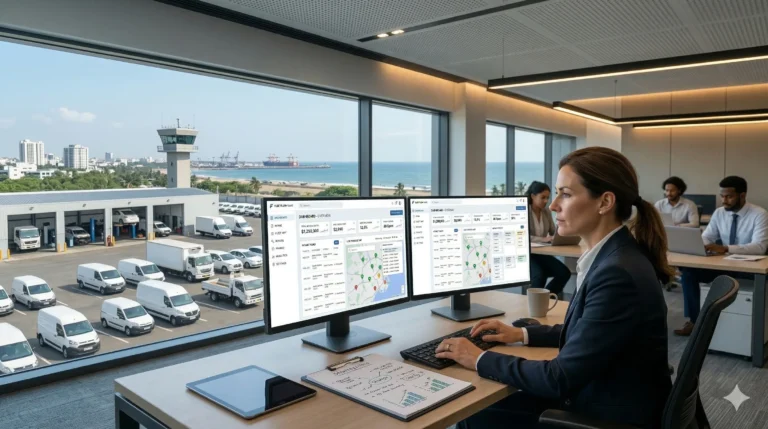
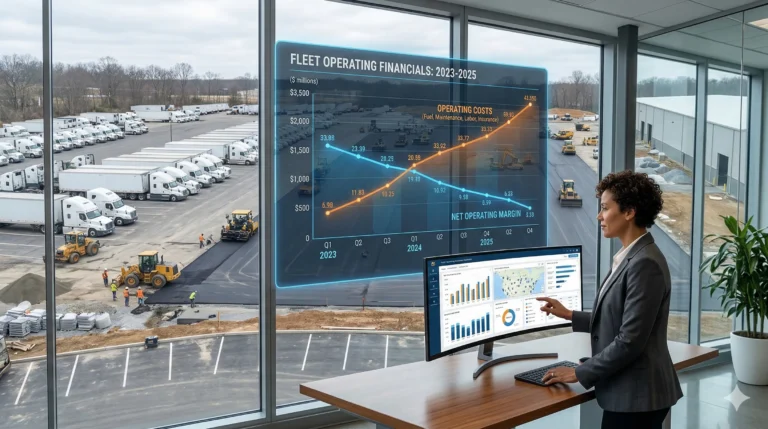
- Management Analytics Dashboards: Unified reporting surfaces profit, loss, and bottlenecks per vehicle and per workflow.
Why Manual Systems Collapse at 500+
Many fleet operators attempt to scale by extending manual processes, but these methods have hard limits.
- Excel Limitations: Spreadsheets lack real-time asset tracking and struggle with concurrent updates. Data becomes outdated and decisions lag.
- Messaging Apps Fail: WhatsApp or similar tools cannot classify urgency, track resolution states, or provide audit trails at scale.
- Verbal Coordination Breaks Down: Relying on calls or in-person updates introduces errors, omissions, and delays.
- Reporting Lag Increases Risk: Manual reporting cycles mean leadership operates on stale data, increasing exposure to operational failures.
Crucially, simply hiring more staff does not resolve this fragmentation. Without systems integration, additional headcount only increases noise, not control.
The Architecture Required for 500+ Vehicle Control
To manage 500+ vehicles efficiently, operational architecture must transition to a closed-loop, integrated system:
- Centralized Customer Care Intake: All requests captured, classified, and routed from a single point.
- Automated Job Classification: Software-driven triage ensures urgent and routine jobs follow distinct workflows.
- Real-Time Traffic Assignment: Dynamic dispatch and reassignment based on live data.
- Workshop Lifecycle Tracking: Every inspection, repair, and approval logged and tracked to reduce bottlenecks.
- Driver Mobile Documentation: Field teams upload photos, receipts, and incident reports directly to the system.
- Dashboard-Level Reporting: Leadership accesses live overviews of asset status, financial performance, and workflow bottlenecks.
When structured CRM platforms integrate with fleet workflow modules, the result is fewer idle days, higher asset utilization, and real-time margin visibility.
FAQ
Because interactions, dependencies, and exceptions grow non-linearly. Each new vehicle adds new workflows and potential conflict points, multiplying operational scenarios.
Systemic fragmentation—when disconnected tools and manual processes lead to missed deadlines, lost revenue, and poor customer experience.
Every extra day a vehicle sits idle is lost revenue and sunk cost. Across hundreds of vehicles, idle days erode profit margins dramatically.
No. Without integrated systems, more staff add communication overhead and increase fragmentation. Workflow automation and dashboards are essential.
Conclusion
At 500+ vehicles, fleet management is no longer about coordination—it’s about operational infrastructure. The companies that scale profitably aren’t the ones with the largest fleets, but those with the most robust workflow architecture. Investing in integrated systems is not optional; it’s the foundation for competitive advantage in the modern fleet landscape.