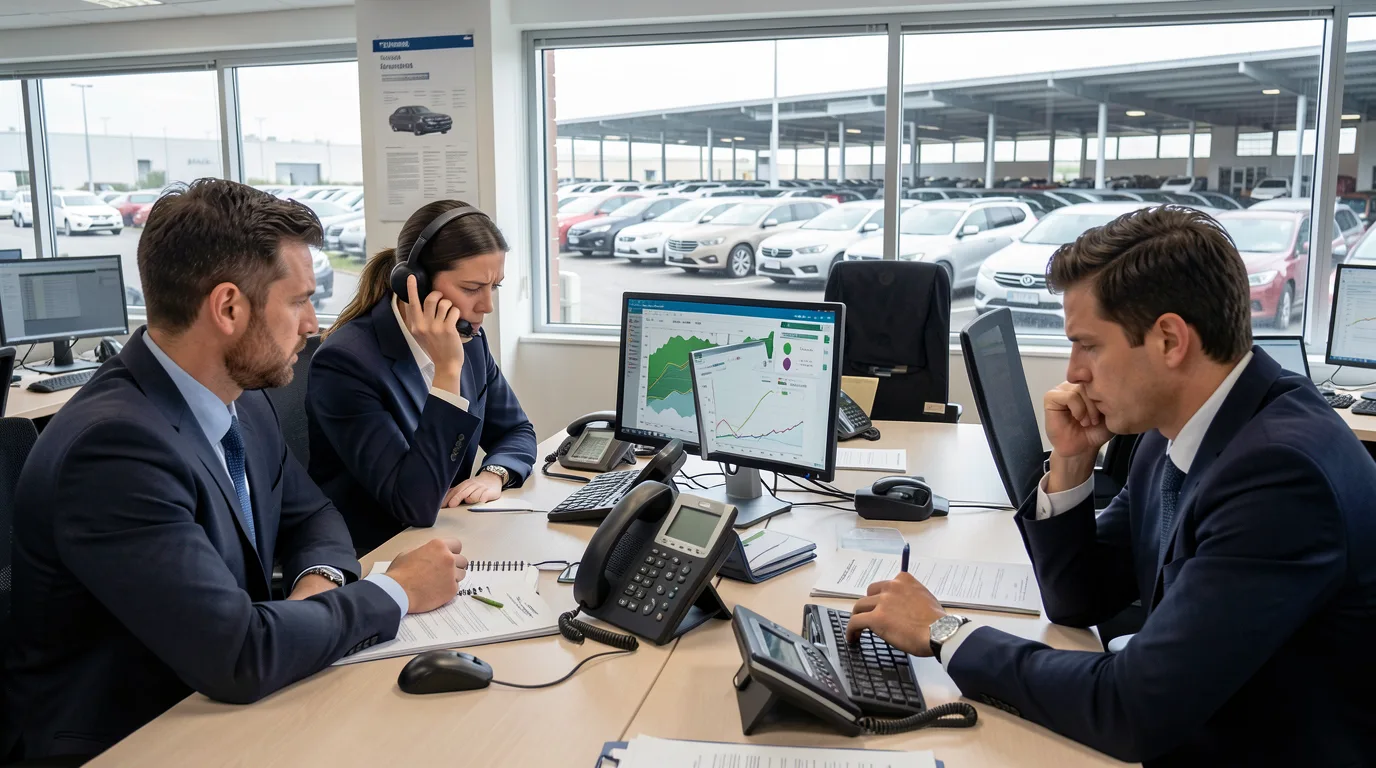
Fleet operations rarely move from smooth sailing to chaos overnight. For owners, operations managers, and directors running fleets of 150–500+ vehicles, the warning signs of operational overwhelm are both measurable and predictable. Recognizing these early signals isn’t just about preventing headaches — it’s about safeguarding profitability and operational integrity before financial and reputational damage occurs.
Overwhelm is a systems architecture issue, not simply a matter of hiring more staff. By understanding and diagnosing the signs of strain, leaders can implement structural fixes that support sustainable growth.
Early Warning Signs in Fleet Operations
Operational strain in fleet management begins long before major breakdowns or customer complaints. These signals often manifest as subtle inefficiencies, delays, or inconsistencies across your processes. Let’s examine the most common and diagnostic early warning signs.
Customer Requests Start Slipping
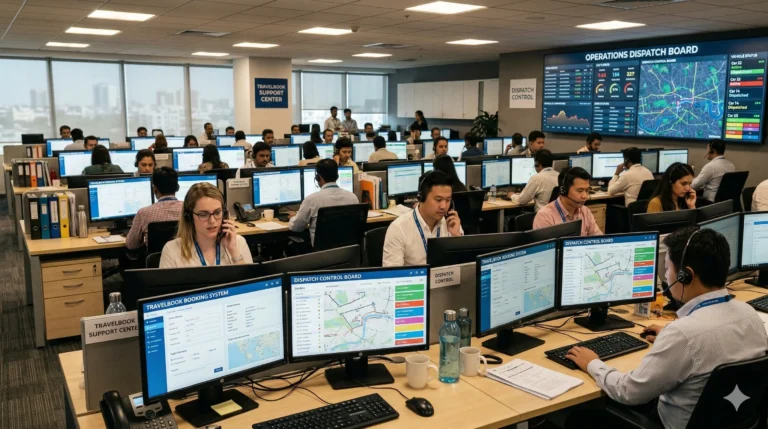
When customer service falters, it’s rarely due to employee effort. Instead, it reflects underlying process or system issues. Notable indicators include:
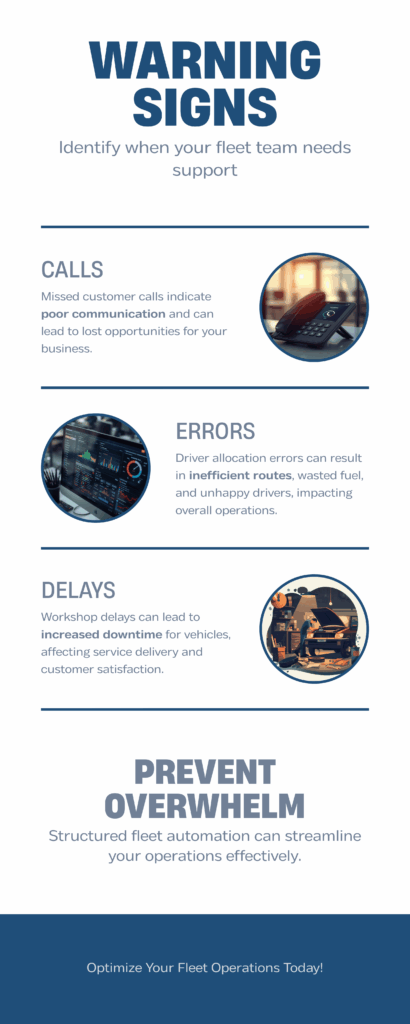
- Missed recovery cases: Vehicles requiring roadside assistance or recovery are often overlooked or delayed, resulting in dissatisfied clients and increased downtime.
- Delayed callback times: Response times to customer issues lengthen, with callbacks or follow-up actions slipping through the cracks.
- Confusion between urgent and non-urgent tickets: Without a structured intake system, your team struggles to triage and prioritize, resulting in critical issues being handled late or missed entirely.
Diagnosis: If your team is increasingly reactive and customers notice slowdowns, your intake classification is likely insufficient. Structured digital intake with automated urgency tagging ensures urgent cases are actioned promptly while routine requests are systematically managed.
Driver Allocation Conflicts Increase
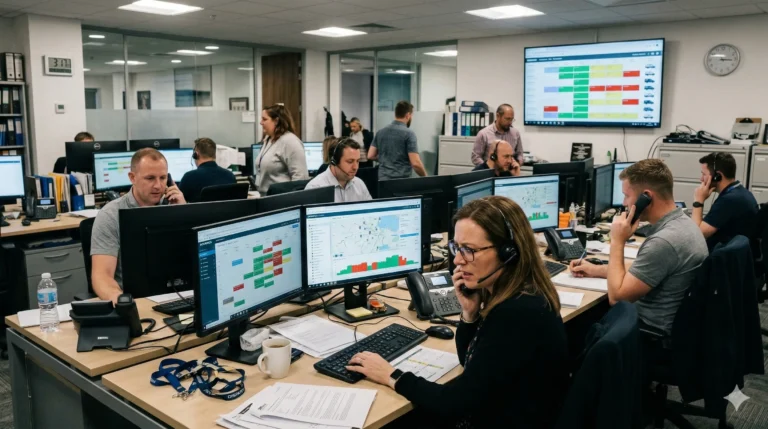
As fleet size and operational complexity grow, so does the challenge of allocating drivers and vehicles efficiently. Key warning signs include:
- Double assignments: Multiple drivers are assigned to the same vehicle or job, causing confusion, inefficiency, and dissatisfaction.
- Replacement vehicle confusion: When a vehicle is out of service, drivers and coordinators struggle to reassign replacements promptly and accurately.
- Manual coordination growing: More time is spent on phone calls, emails, and spreadsheets to resolve allocation issues, increasing the risk of human error.
Diagnosis: These conflicts signal that your current allocation process has outgrown manual tracking. Implementing real-time traffic dashboard logic, where assignments and statuses are visible and dynamically updated, is essential to scale effectively.
Workshop Turnaround Times Stretch
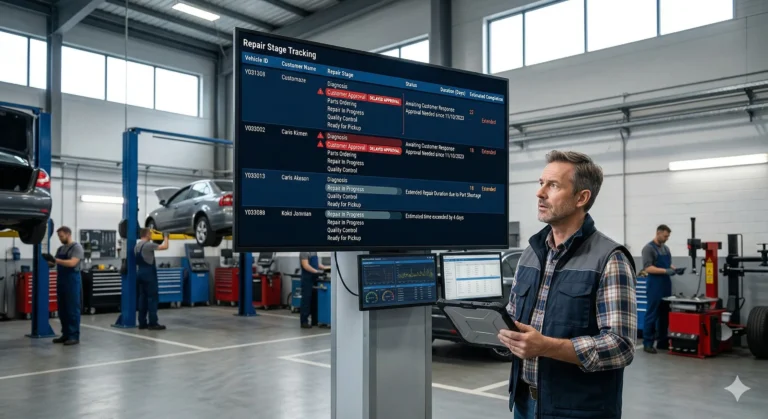
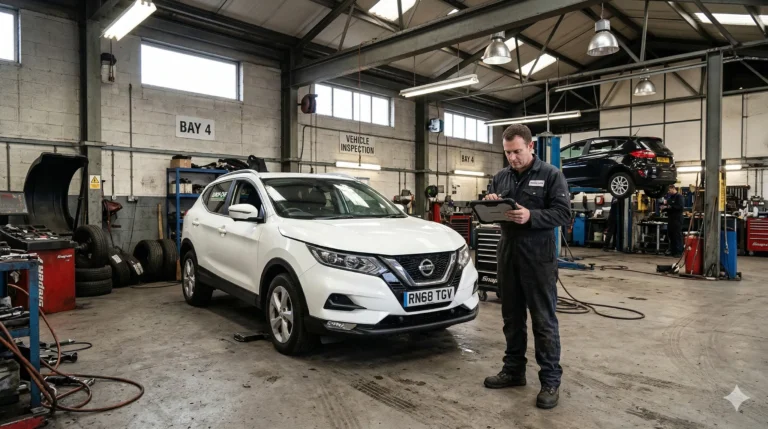
Repair and maintenance are central to keeping a fleet operational. When workshop processes falter, operational risk and costs escalate. Key signals include:
- More vehicles waiting for approvals: Vehicles spend excessive time idle because job approvals or part authorizations are delayed.
- Quotes pending longer: Workshop estimates take days to be reviewed, approved, or returned, extending vehicle downtime.
- Idle days increasing: Vehicles log more non-operational days in the yard, impacting revenue and customer satisfaction.
Diagnosis: These indicate bottlenecks in the workshop lifecycle. Advanced tracking systems that monitor each repair stage and trigger reminders for pending approvals can reduce idle time and ensure faster turnarounds.
Reporting Takes Longer Every Month
Reliable, timely reporting is the backbone of effective fleet management. As operations strain, reporting inefficiencies multiply:
- Management reports manually compiled: Team members spend hours or days gathering data from disparate sources.
- Inconsistent cost tracking: Expenses are entered late, inaccurately, or not at all, compromising budget control.
- No per-vehicle profitability visibility: Without granular analytics, you lack clarity on which assets are profitable — or are quietly draining resources.
Diagnosis: If reporting cycles are getting longer and less reliable, it’s time to automate data collection and dashboard reporting. Modern fleet analytics platforms integrate with operational systems to provide real-time, actionable insights.
Your Team Is Always “Busy” but Progress Feels Slow
One of the most insidious signs of overwhelm is a team that is perpetually busy, yet key initiatives stall and escalations increase. Look for:
- Reactive mode: The day is spent fighting fires, with little proactive planning or process improvement.
- No structured job lifecycle: Tasks move haphazardly from one person to another, with no clear ownership or process checkpoints.
- Escalations increasing: More issues are pushed up to management due to unresolved problems at the operational level.
Diagnosis: Workflow fragmentation is at the root. Lack of process clarity and automation leads to duplicated work, missed tasks, and managerial overload. Workflow management platforms bring structure and accountability, ensuring jobs flow efficiently from start to finish.
Why Overwhelm Happens Before Fleet Growth Peaks
A common misconception is that operational overwhelm only occurs once a fleet reaches a certain size. In reality, the risk grows exponentially as complexity, not just vehicle count, increases.
- Complexity grows faster than vehicle count: Adding vehicles increases not just jobs, but also dependencies, communication channels, and points of failure.
- Communication density increases: More people involved means more opportunities for miscommunication, especially if relying on manual systems.
- Dependencies multiply: Each process — from bookings to repairs — becomes interlinked, meaning a failure in one area creates cascading issues elsewhere.
- Manual systems fail under operational pressure: Spreadsheets, emails, and paper-based systems can’t keep up with the real-time demands of a growing fleet.
Consequently, teams experience overwhelm well before reaching their theoretical capacity. Recognizing these early signals — and acting on them — is critical to scaling efficiently.
The Structural Fix Before Breakdown
The antidote to operational overwhelm is not more staff or longer hours — it is a robust systems architecture that scales with your business. Before the cracks become chasms, implement the following:
- Centralized intake system: All customer and internal requests are funneled through a single platform, ensuring nothing is missed and everything is prioritized correctly.
- Automated job classification: Intelligent systems classify and route jobs based on urgency, type, and required resources, reducing manual triage and errors.
- Real-time traffic allocation: Driver and vehicle assignments are managed through dashboards that update in real time, minimizing conflicts and confusion.
- Workshop lifecycle tracking: Every stage of the repair and maintenance process is logged, with automated reminders for pending actions, ensuring faster turnaround.
- Driver mobile documentation: Enable drivers to report, update, and complete tasks from the field, reducing paperwork and speeding up job cycles.
- Executive analytics dashboard: Leadership has immediate access to key operational and financial metrics, supporting data-driven decisions and proactive issue resolution.
Notably, these systems prevent overwhelm by embedding structure and automation into the heart of your operations. Rather than responding to problems as they arise, your team operates within a framework designed for scale and resilience.
Frequently Asked Questions
Look for measurable delays: longer response times, growing backlogs, frequent double-assignments, and increasing escalations. If your team is always busy but progress is slow, your system is likely under strain.
Intake and allocation processes usually fail first — missed tickets, delayed assignments, and confused priorities signal early-stage overwhelm.
No. Without structural changes, additional staff simply mask underlying issues. Sustainable solutions require system and process upgrades, not just headcount increases.
Automation eliminates repetitive manual work, reduces errors, and provides real-time visibility into operations. This empowers teams to focus on high-value tasks and prevents bottlenecks.
Overwhelm can start as early as 150 vehicles if processes aren’t scalable. The tipping point depends on operational complexity and system maturity, not just the number of vehicles.
Conclusion
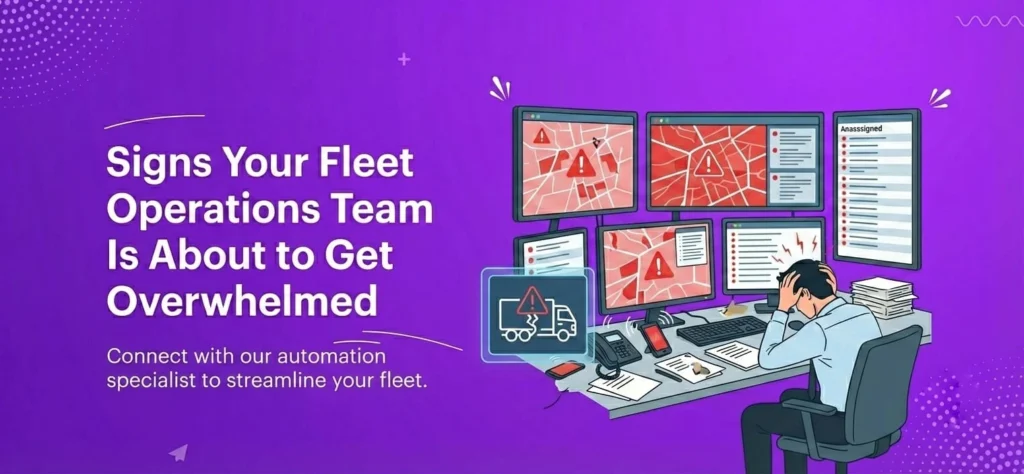
Overwhelm is not a staffing failure — it’s an infrastructure warning. Ultimately, fleet leaders who interpret these signals as systemic issues, rather than lapses in personnel, are the ones who scale with control and confidence. By investing in robust systems architecture before crisis hits, you ensure your fleet operations can grow without sacrificing efficiency or profitability.