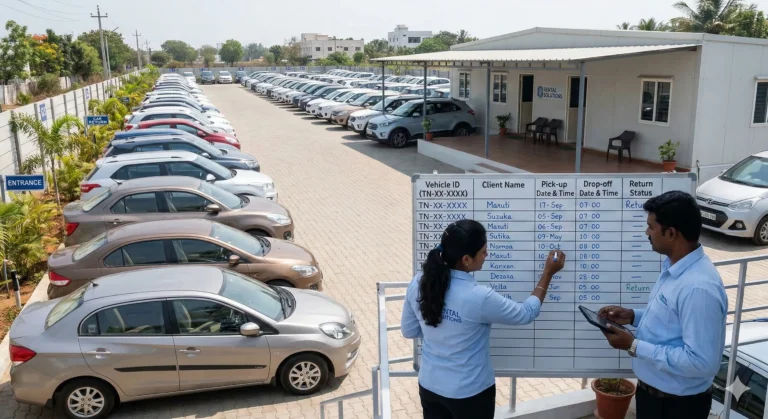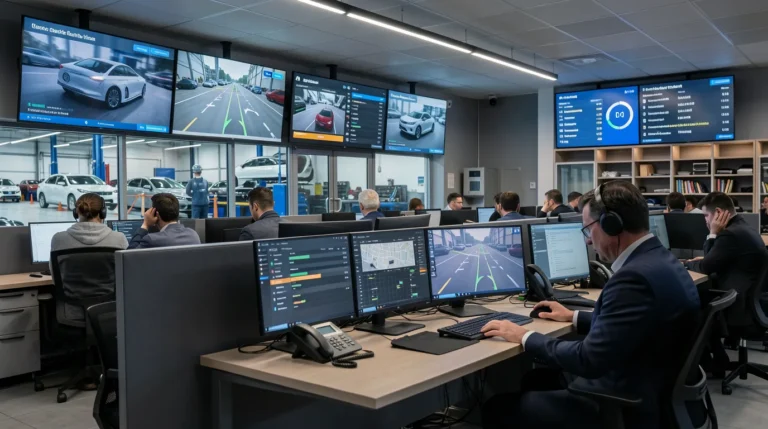

Manual service scheduling is one of the most overlooked causes of operational delays in large rental fleets. As vehicle count increases, scheduling preventive maintenance using spreadsheets, phone calls, and manual reminders creates invisible bottlenecks that compound over time. These hidden inefficiencies disrupt fleet availability, inflate operational costs, and undermine profitability. Notably, manual service scheduling is the root operational risk for any rental fleet seeking to scale efficiently.
Why Service Scheduling Becomes Complex at Scale
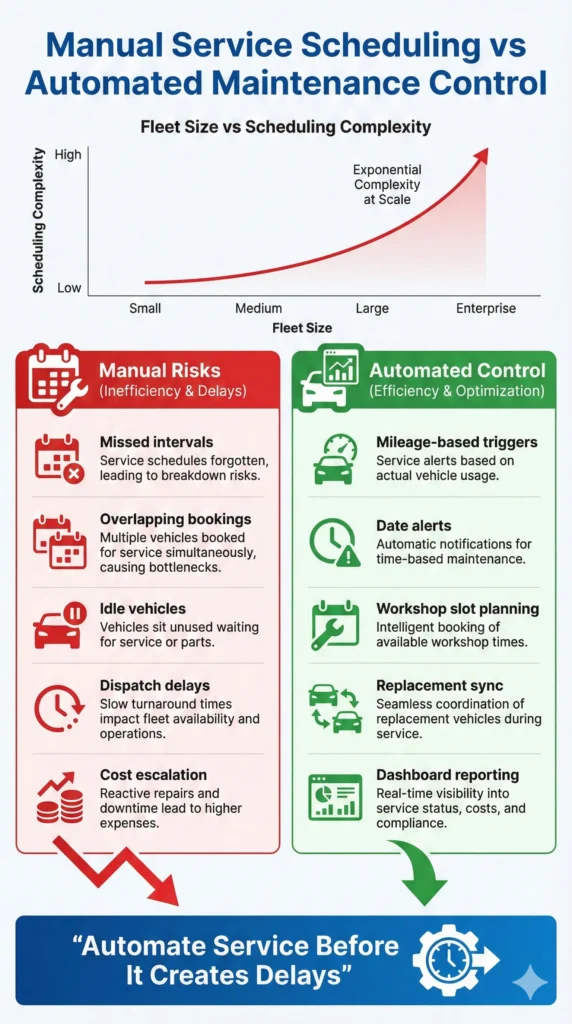
As rental fleets expand, preventive maintenance becomes exponentially more complex. Unlike small operations, where a handful of vehicles can be tracked with basic tools, large fleets encounter overlapping service cycles, mileage-based triggers, and the need to coordinate multiple workshops.
For example, vehicles on different duty cycles accumulate mileage at varying rates, causing preventive maintenance schedules to diverge. Consequently, overlapping service intervals require more granular planning. Moreover, as vehicles are rotated between locations to balance utilization or meet customer demand, scheduling conflicts multiply, and coordinating maintenance windows becomes increasingly difficult.
The involvement of multiple workshops further complicates the process. Each workshop may have different capacity constraints, operating hours, and service specialties. Manual scheduling rarely accounts for these nuances, resulting in underutilized or overbooked workshops. Ultimately, as fleet density increases, so does the risk of scheduling conflicts and operational delays.
The Hidden Delays Caused by Manual Tracking
Manual service scheduling systems, such as spreadsheets and ad hoc reminders, inevitably lead to hidden operational delays. Missed service intervals are common, exposing vehicles to higher risk of breakdowns. Moreover, overdue maintenance becomes a recurring issue, as reminders get buried in inboxes or overlooked during busy periods.
Duplicate workshop bookings are another frequent consequence. Without centralized visibility, multiple vehicles may be scheduled for the same slot, forcing rescheduling and extending vehicle downtime. Idle vehicles often accumulate while waiting for approvals or workshop availability, further reducing fleet utilization.
Additionally, manual systems rarely track or communicate estimated ready dates. This lack of transparency leaves traffic and operations teams in the dark, causing cascading delays in vehicle dispatch and customer fulfillment. Ultimately, manual tracking converts what should be a predictive servicing process into a reactive one, undermining operational efficiency.
Workshop & Traffic Coordination Gaps
One of the most significant drawbacks of manual service scheduling is the lack of synchronization between workshops and traffic teams. Service bookings are often made without considering real-time driver allocation, leading to last-minute scrambles when vehicles are unexpectedly taken offline.
Moreover, with no real-time visibility into workshop capacity, vehicles may be dispatched to locations already operating at full capacity, resulting in unnecessary wait times. Replacement vehicles, crucial for maintaining service commitments, are rarely pre-planned, leaving customers or internal stakeholders without alternatives during maintenance periods.
Dispatch delays are common during preventive service events, as the lack of workflow integration becomes apparent. This disconnect not only frustrates drivers and customers but also erodes trust in the fleet’s reliability. Therefore, service scheduling must be viewed as a core component of broader workflow synchronization, not a standalone administrative task.
Financial Impact of Poor Scheduling
The operational delays caused by manual service scheduling have a direct and measurable financial impact. Increased breakdown frequency is one of the most visible consequences, as missed or delayed maintenance leads to unexpected failures. Consequently, fleets incur higher repair costs, which could have been avoided with timely preventive servicing.
Warranty loss is another significant risk. Many manufacturers require strict adherence to maintenance schedules; missed intervals can void warranties, shifting repair costs entirely to the fleet operator. Unplanned downtime, resulting from inefficient scheduling, reduces revenue per vehicle and inflates overhead costs.
Notably, tracking per-vehicle profitability becomes nearly impossible without structured scheduling and maintenance records. As a result, fleet owners lose visibility into which assets are underperforming or incurring excess costs. Therefore, robust service scheduling is not merely operational best practice—it is a critical control mechanism for protecting fleet margins.
The Structured Alternative: Automated Service Scheduling
To eliminate these operational delays, large rental fleets are increasingly turning to automated service scheduling solutions. Automated systems leverage mileage-based triggers and date-based alerts to ensure that preventive maintenance is performed exactly when needed, regardless of vehicle location or usage pattern.
Workshop slot forecasting enables proactive planning, ensuring that service events are scheduled based on real-time workshop capacity and workload. Moreover, the pre-allocation of replacement vehicles ensures uninterrupted service delivery and customer satisfaction.
At the heart of these solutions is dashboard-level visibility. Fleet managers can monitor maintenance status, upcoming service needs, and workshop availability in real time. This closed-loop service management system transforms maintenance from a reactive burden into a strategic advantage, reducing downtime and maximizing asset utilization.
FAQ: Manual vs. Automated Service Scheduling
Manual scheduling relies on human input and fragmented tools, leading to missed service intervals, scheduling conflicts, and lack of real-time visibility, which all cause operational delays.
While the tipping point varies, most fleets find manual methods unsustainable beyond 30–50 vehicles. Complexity increases sharply as vehicle count and operational density grow.
Timely preventive maintenance minimizes unplanned downtime by addressing issues before they lead to breakdowns, ensuring higher fleet availability.
Yes, automated scheduling forecasts workshop capacity and allocates service slots efficiently, preventing overbooking and reducing idle vehicle time.
Key performance indicators include average downtime per vehicle, percentage of on-time maintenance, repair cost per vehicle, and workshop utilization rates.
Conclusion
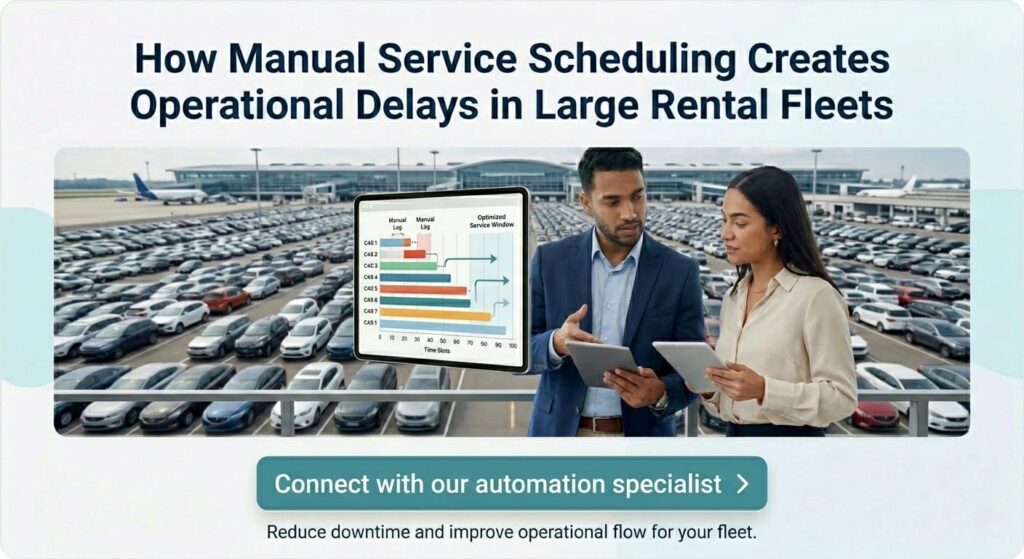
Manual service scheduling works in small fleets. In large fleets, it creates invisible operational drag. Companies that automate service triggers, workshop tracking, and replacement planning eliminate unnecessary downtime and maximize vehicle utilization.